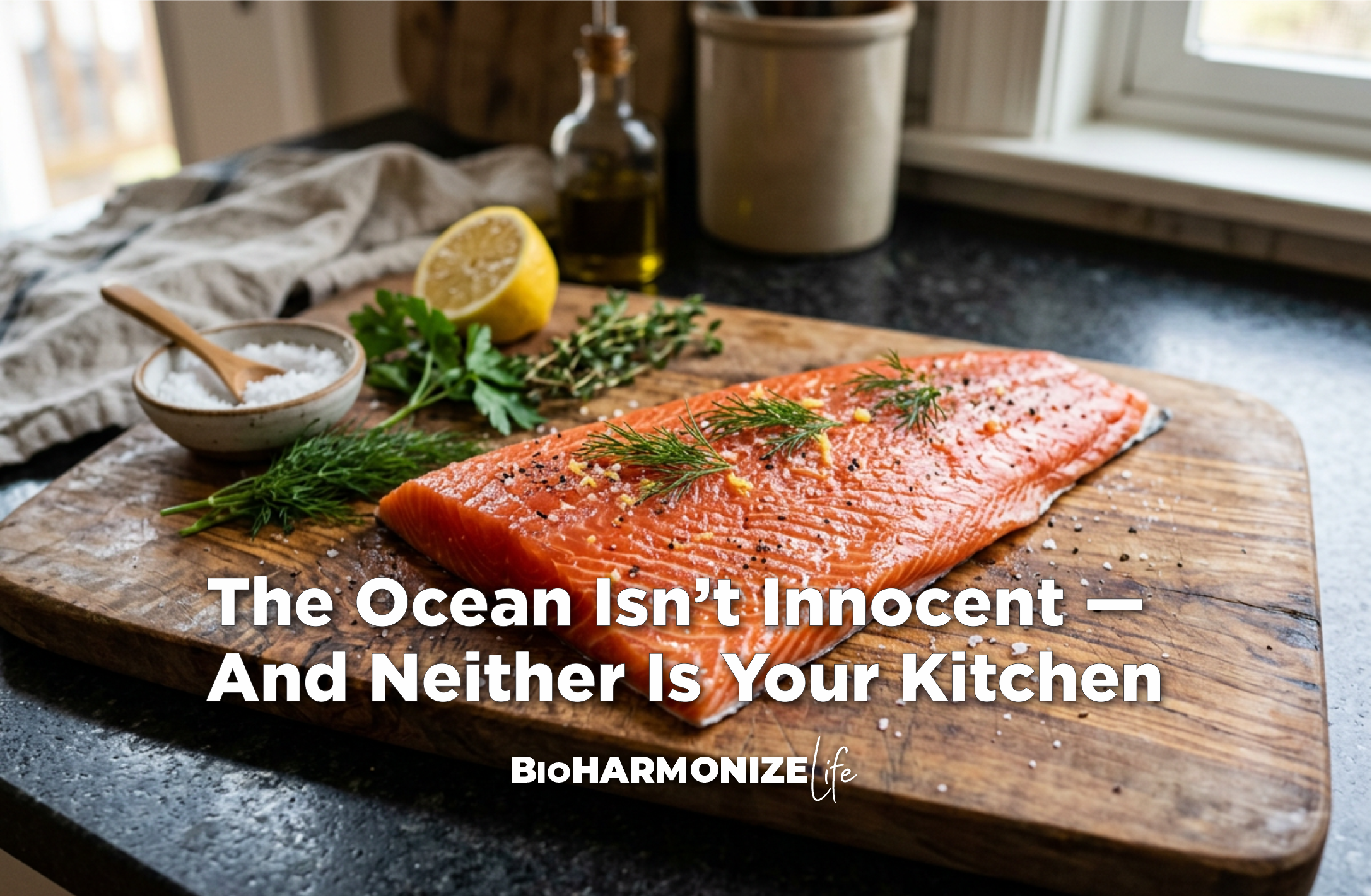
The Ocean Isn’t Innocent — And Neither Is Your Kitchen
Mercury now contaminates most commercial fish. Microplastics have invaded every ocean basin. Industrial aquaculture pushes out fish raised on antibiotics, synthetic dyes, and crowded pens that violate creation’s design.
People think the solution is simple: Buy cleaner seafood.
But even those who invest in regenerative, nutrient‑dense fish are missing the final battlefield — their own kitchen.
“My people perish for lack of knowledge.” — Hosea 4:6 This is one of those places where knowledge becomes stewardship.
The Hidden Threat: Your Kitchen Is a Contamination Zone
Omega‑3 rich seafood is lipophilic — fat‑loving. That means it absorbs whatever it touches.
The oils. The papers. The spices. The condiments. Even the storage containers.
A pristine, clean, nutrient‑dense fillet can be compromised in minutes if the kitchen environment is sloppy.
“A little leaven leavens the whole lump.” — Galatians 5:9 One small contaminant can undo the purity of the whole.
The Three Silent Contaminants Sabotaging Your Food
1. Paper Products
Most parchment and baking papers are coated with PFAS — the “forever chemicals” that don’t break down in your body.
Avoid
-
Chlorine‑bleached parchment
-
PFAS‑coated baking paper
-
Synthetic wax paper
-
Fragranced napkins
Upgrade
-
Unbleached parchment
-
Recycled paper towels
-
Silicone baking mats (bake the empty mat 2–3 times first)
-
Unbleached, bamboo or cloth napkins
“Test everything; hold fast what is good.” — 1 Thessalonians 5:21
2. Salt
Refined table salt is stripped of minerals and loaded with anti‑caking agents.
Avoid
-
Refined iodized table salt
-
Anti‑caking chemicals
Upgrade
-
Mineral‑rich sea salt
-
Flake finishing salt
-
High‑quality pouring salt
Salt is covenantal. It was never meant to be synthetic or stripped.
“You are the salt of the earth.” — Matthew 5:13 Salt should strengthen, not pollute.
3. Spices
Old, light‑exposed spices lose potency and can harbor contaminants.
Avoid
-
Bulk bin spices
-
Clear jars
-
Cheap blends with fillers
-
Additive‑loaded seasonings
Upgrade
-
Whole spices, fresh‑ground
-
Dark glass storage
-
Single‑origin sourcing
-
Replace yearly
“Let your seasoning be with grace.” — Colossians 4:6 (paraphrased) Purity in, purity out.
The Condiment Trap
This is where most people destroy a perfect piece of fish.
Oils
Avoid
-
Soybean
-
Canola
-
Vegetable blends
-
Corn oil
Choose Instead
-
Extra virgin olive oil
-
Avocado oil
-
Cold‑pressed coconut oil
-
Grass‑fed butter or ghee
Fermented Foods
Choose naturally fermented soy sauce, fish sauce, and vinegars — not synthetic imitations with sugar and preservatives.
Sweeteners
Use raw honey, real maple syrup, or coconut sugar. Skip HFCS and artificial sweeteners.
Red Flags
Watch for:
-
“Natural flavors”
-
MSG
-
Modified starches
-
Caramel coloring
“Be sober‑minded; be watchful.” — 1 Peter 5:8 Even in the kitchen.
The Non‑Toxic Kitchen Checklist
Audit your kitchen like a steward, not a consumer.
-
No scratched non‑stick cookware
-
Stainless steel or cast iron only
-
Glass or stainless storage
-
No plastic wrap on fatty foods
-
Wood or bamboo cutting boards
-
Filtered water for cooking
-
No reheated oils
-
Unbleached parchment only
-
Whole spices replaced yearly
-
Fermented condiments over synthetic
“Whatever you do, do it unto the glory of God.” — 1 Corinthians 10:31 Even the way you cook.
When You Start With Clean Seafood, Everything Changes
Clean, regenerative, nutrient‑dense seafood is the foundation. But the kitchen is the proving ground.
A clean input deserves a clean environment. That’s how you honor the body, the design, and the covenant.